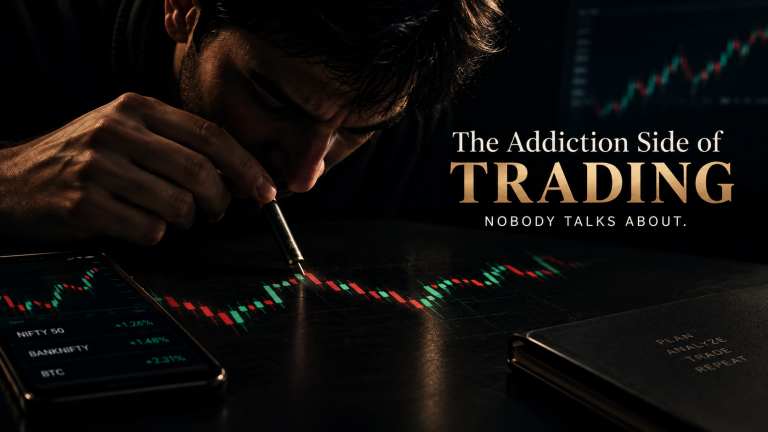
Trading is often presented as a game of charts, strategies, indicators, probability and discipline.
But there is another side of trading that rarely gets discussed openly:
the psychological reward of trading itself.
For some traders, the market eventually becomes more than a place to execute a strategy.
It becomes a source of excitement.
A source of validation.
A way to escape boredom.
A way to recover from a bad day.
A way to chase the feeling of being right.
And that’s where things can become dangerous.
Because you don’t necessarily need to lose money every day to develop an unhealthy relationship with trading.
Sometimes, winning can reinforce the behavior just as strongly.
The Trade Wasn’t Always About the Trade
Imagine this.
You sit down at your desk.
You weren’t planning to trade.
You open your charts anyway.
You see a small setup.
It isn’t really part of your strategy.
But it looks interesting.
You enter.
Your heart rate changes.
Now you’re watching every candle.
The position moves in your favor.
You feel the rush.
You close for a small profit.
And suddenly, you want another trade.
Not because another high-quality setup exists.
Because you want that feeling again.
This distinction matters.
There is a difference between:
“I found an opportunity.”
and
“I want to trade.”
A disciplined trader waits for the first.
A compulsive trader starts looking for reasons to justify the second.
The Trading Dopamine Loop
Trading can create a powerful cycle:
Anticipation → Entry → Uncertainty → Outcome → Emotional Reward → Desire to Repeat
The outcome doesn’t even have to be positive.
A win can produce excitement.
A loss can create frustration.
Both can make you want to interact with the market again.
And that’s one of the reasons simply telling yourself to “be disciplined” isn’t always enough.
You need to understand what behavior you’re reinforcing.
Why Winning Can Be Dangerous Too
Everyone understands why repeated losses can be destructive.
But winning can create its own problems.
Imagine you break your rules and make ₹10,000.
Your brain doesn’t necessarily record:
“I violated my trading plan.”
It may record:
“That worked.”
Now the behavior has been rewarded.
Next time, you take another low-quality trade.
Maybe it works again.
You start believing that your rules are unnecessary.
Position sizes increase.
Trade frequency increases.
Your confidence increases.
Then eventually, the market gives you the trade that doesn’t work.
And suddenly you’re trying to recover.
This is how a trader can gradually move from:
strategy → deviation → reinforcement → overconfidence → loss → revenge → repetition.
The problem wasn’t necessarily one bad trade.
It was the behavioral loop surrounding it.
Revenge Trading: When the Market Becomes Personal
Few phrases are more dangerous than:
“I just need to make it back.”
You lose ₹5,000.
Instead of closing the platform, you start calculating how quickly you can recover it.
Maybe you normally risk ₹1,000.
Now you risk ₹2,000.
You lose again.
Now you’re angry.
You increase size again.
At this point, you’re no longer executing the strategy that created your original trading results.
You’re attempting to change the outcome of the previous trade.
But the market doesn’t know you lost money.
It doesn’t owe you anything.
And it certainly doesn’t know that you’re trying to get your money back.
The market is indifferent.
Your brain isn’t.
The “One More Trade” Problem
One of the most underestimated behaviors in trading is the need for one more trade.
You planned three trades.
You took three.
You’re done.
Then you notice another setup.
You tell yourself:
“This one looks really good.”
You take it.
Then another appears.
And another.
Eventually, your trading day isn’t determined by your strategy anymore.
It’s determined by how long you can resist clicking.
That’s why a trading plan should contain not only entry rules, but also stopping rules.
For example:
- Maximum number of trades per day
- Maximum daily loss
- Maximum position size
- Conditions that invalidate your setup
- Mandatory review after a loss
- Rules for stepping away from the market
A professional process needs an off switch.
The Hidden Addiction: Checking Your P&L
Here’s another behavior traders rarely talk about.
Checking P&L constantly.
You open a trade.
You check.
The position is green.
You feel good.
It turns red.
You feel anxious.
It turns green again.
You check again.
Again.
Again.
Eventually, your attention isn’t on the quality of your decision.
It’s on the number moving on the screen.
And that can completely change how you manage the position.
You might exit a good trade too early because the unrealized profit makes you nervous.
Or hold a bad trade because you can’t accept the loss.
The number becomes emotionally louder than the plan.
Your Brain Can Remember the Win. Your Journal Remembers the Truth.
This is where documentation becomes powerful.
Human memory is selective.
After a few months of trading, you may remember:
“I had some really good trades.”
But your actual data might tell a different story.
Maybe your biggest losses came from:
- Trading outside your setup
- Increasing size after losses
- Trading during specific hours
- Taking too many trades
- Moving stop losses
- Entering without confirmation
- Trading while emotionally frustrated
Without records, these patterns remain invisible.
With records, they become measurable.
That’s the difference between:
“I think I have a problem with overtrading.”
and
“38% of my losing trades this month came after my daily trade limit.”
The second statement gives you something you can actually work on.
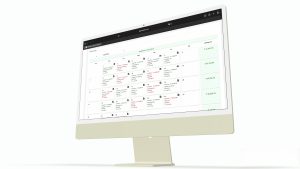
A Trading Journal Isn’t Just a P&L Tracker
A serious trading journal should capture more than:
Entry → Exit → Profit/Loss
It should help you understand why you traded.
Ask yourself:
Before the trade
- What was the setup?
- Why did I enter?
- Was this part of my plan?
- What was my risk?
- How confident was I?
During the trade
- Did I follow my rules?
- Did I interfere with the position?
- Did my emotions change?
After the trade
- What happened?
- Was the execution good?
- Was the outcome simply variance?
- What would I repeat?
- What would I change?
And perhaps the most important question:
“Would I take this exact trade again under the same conditions?”
That question separates outcome-based thinking from process-based thinking.
The Difference Between a Bad Trade and a Bad Decision
This is critical.
A good trade can lose money.
A bad trade can make money.
That’s why P&L alone cannot tell you whether you traded well.
Suppose you followed your strategy perfectly, respected your stop loss and managed your risk correctly—and lost.
That’s not necessarily a bad decision.
Now suppose you ignored your setup, doubled your position and moved your stop—and somehow made money.
That’s not necessarily a good decision.
Outcome and execution are different things.
If you only record the outcome, you miss the lesson.
When Trading Becomes an Emotional Escape
Sometimes the problem isn’t the market.
It’s what the market provides emotionally.
For one person, trading might provide excitement.
For another, it might provide distraction.
For another, it might provide a sense of achievement.
For someone else, it might become a way to escape problems outside the market.
And that creates an uncomfortable question:
“Would I still want to trade right now if there were no money involved?”
If the answer is no, it’s worth asking what you’re actually seeking from the activity.
Because trading should be a process.
Not an emotional medication.
Signs Your Relationship With Trading May Be Becoming Unhealthy
There isn’t one universal checklist that defines a trading addiction, and these behaviors don’t automatically mean someone has a clinical disorder.
But repeated patterns such as these deserve attention:
- Trading far more frequently than planned
- Increasing risk to recover losses
- Breaking your own rules repeatedly
- Hiding losses or trading activity from others
- Feeling unusually restless when you’re not trading
- Trading primarily because you’re bored
- Continuing after reaching your daily limit
- Chasing losses
- Allowing trading to interfere with sleep, work or relationships
- Feeling that you need to make money back immediately
- Continuing despite recognizing that the behavior is damaging you
The important part isn’t one isolated incident.
It’s the pattern.
The Solution Isn’t “Never Trade Again”
For someone who genuinely wants to trade, the goal isn’t necessarily to eliminate every emotional response.
You’re human.
You will experience fear.
You will experience excitement.
You will experience frustration.
The goal is to build a system where your emotions don’t get to decide your actions.
That means creating rules before you’re emotional.
Not after.
Build Friction Between Emotion and Execution
One of the simplest ways to reduce impulsive decisions is to make impulsive trading harder.
For example:
Rule: Maximum 2 trades per day.
Once trade #2 is closed:
Platform closed.
No exceptions.
Rule: Stop trading after reaching your daily loss limit.
Once reached:
Done for the day.
Rule: Every trade requires a journal entry.
No journal entry:
No trade.
These rules turn discipline from a feeling into a system.
You don’t have to repeatedly ask:
“Do I have enough self-control today?”
The system answers for you.
The Most Powerful Question a Trader Can Ask
Before pressing the button, ask:
“Am I taking this trade because my system says I should—or because I want to trade?”
That single question can expose a lot.
Because sometimes the setup isn’t the reason.
The desire to participate is.
And the market will always provide enough noise to make participation feel justified.
Trade Less. Observe More.
The goal of becoming a better trader isn’t necessarily to find more opportunities.
It can be to become better at recognizing which opportunities deserve your attention.
Your trading history contains information about you:
Your best setups.
Your worst hours.
Your recurring mistakes.
Your emotional triggers.
Your risk behavior.
Your discipline.
Your consistency.
But you can’t improve patterns you refuse to see.
And you can’t see patterns you don’t record.
Your trading journal isn’t there to remind you how much money you made.
It’s there to show you how you behaved when money was on the line.
That’s where real improvement begins.
Final Thought
The most dangerous trading addiction isn’t necessarily the addiction to money.
It can be the addiction to action.
The need to be in a trade.
The need to recover.
The need to prove yourself right.
The need to feel the next win.
The need to see the next candle.
Eventually, the question changes from:
“Is there a trade?”
to:
“Why do I feel like I need to trade?”
Learn to recognize that difference.
Because sometimes the most professional decision you can make isn’t entering the market.
It’s closing the charts.
LINCFOLIO Takeaway
Don’t just track your trades. Track yourself.
Record the setup.
Record the decision.
Record the emotion.
Record the execution.
Then review the pattern.
Because the goal isn’t simply to know what happened to your money.
It’s to understand what happened to your decision-making.
LINCFOLIO — Trading Journey Simplified.