Most traders think they know why they win or lose.
But after journaling 100 trades, you realize something life-changing:
Your beliefs about your trading are almost always wrong.
Your data tells a completely different story.
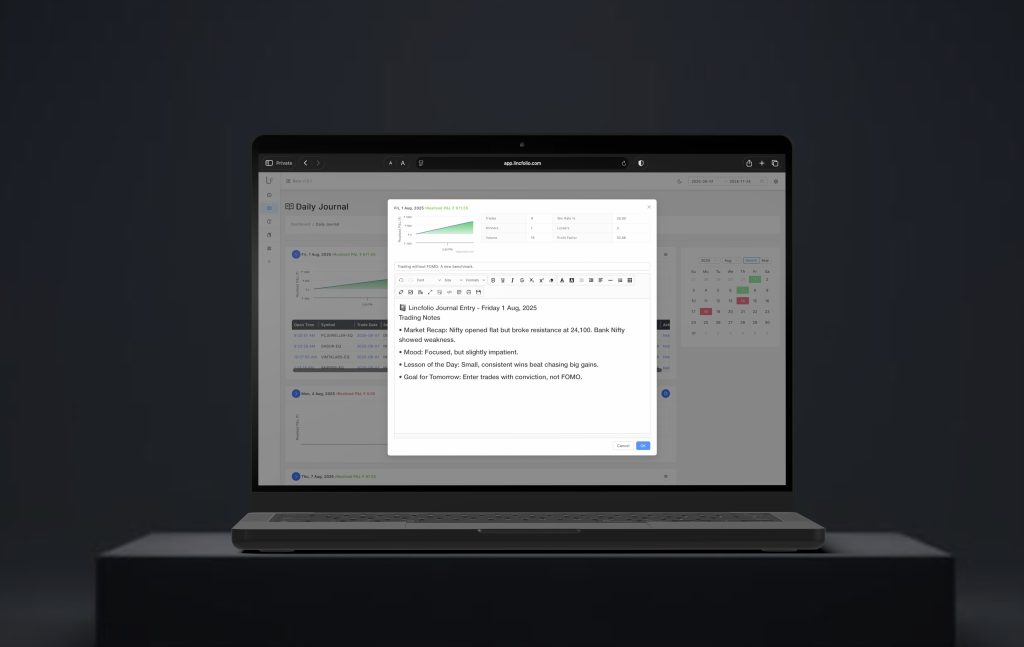
What I discovered after documenting 100 trades inside Lincfolio reshaped my entire approach to the markets. These are the lessons every trader eventually learns the hard way or the smart way.
⸻
🔥 1. Your Best Trades Come From Only One or Two Setups
I entered the challenge believing I had 5–6 solid strategies.
My journal said otherwise.
After reviewing 100 entries:
•2 setups produced 82% of my total profits
•3 setups consistently lost money
•1 setup was profitable only in trending markets
I wasn’t a “versatile” trader.
I was just overtrading.
Big Realization:
Your edge is smaller than you think and far more powerful when you focus on it.
⸻
📊 2. Time of Day Matters More Than Most Traders Believe
Before journaling, I traded all day.
After 100 trades, the truth slapped me hard:
•Most of my winning trades were within the first 90 minutes
•Most of my losing trades were taken after 1 PM
The afternoons weren’t just bad, they were consistently bad.
Big Realization:
You don’t need more time in the market.
You need to trade only during your profitable hours.
⸻
😬 3. Emotions Decide More Than Technicals
Everyone talks about strategies.
Almost no one talks about emotions.
After tracking emotional states for 100 trades, I learned:
•Overconfidence destroyed more trades than fear
•Impatience caused premature entries
•Revenge trades happened within 15 minutes of a loss
•Low-energy trades (tired/stressed) were almost always losers
Big Realization:
Market patterns don’t cause losses, emotional patterns do.
⸻
⚠️ 4. Rule-Breaking Is the Real Account Killer
When I marked every trade as:
✔ Followed all rules
✘ Broke rules
… the results were shocking:
•Rule-following trades were net profitable
•Rule-breaking trades wiped out ALL profits
It wasn’t the strategy.
It wasn’t the market.
It wasn’t bad luck.
It was me.
Big Realization:
You don’t need a new setup.
You need to stop betraying your own system.
⸻
🧩 5. Small Mistakes Compound Faster Than Profits
Across 100 trades, the biggest leaks came from:
•Entering slightly early
•Exiting slightly late
•Moving stop-loss “just a little”
•Increasing size after a win
•Taking “boredom trades”
Individually, these felt harmless.
Together, they were poison.
Big Realization:
Tiny mistakes become massive losses over time, unless you track them.
⸻
🎯 6. Your Risk Management Defines Your Identity as a Trader
One of the most surprising discoveries:
•When I risked more — I acted worse
•When I risked less — I acted professionally
Higher risk magnified:
•Impulsiveness
•Fear
•FOMO
•Attachment to outcomes
Lower, consistent risk created clarity.
Big Realization:
Your risk defines your psychology.
Your psychology defines your results.
⸻
🔍 7. Reviewing Trades Is Where the Real Growth Happens
Journaling each trade helped.
Reviewing them helped 10x more.
Weekly reviews inside Lincfolio exposed:
•Patterns I couldn’t see during the week
•Dangerous habits forming
•Strengths I should double down on
•Market conditions that suited me best
Big Realization:
Improvement doesn’t happen during trading.
It happens during reflection.
⸻
⭐ 8. Consistency Isn’t About Winning, It’s About Knowing Yourself
After 100 trades, I learned:
•I don’t need more strategies
•I don’t need more indicators
•I don’t need more screen time
What I needed was:
•Structure
•Discipline
•Awareness
•Emotional control
•A repeatable system
•Clear data
And that’s exactly what journaling creates.
Final Big Realization:
The market doesn’t need to change.
You do.
And journaling shows you exactly how.
⸻
💎 Conclusion: 100 Trades Can Rewrite Your Entire Trading Identity
Journaling isn’t paperwork.
It’s the most powerful transformation tool a trader can use.
After 100 trades with Lincfolio, I learned:
✔ My real edge
✔ My natural strengths
✔ My dangerous habits
✔ My best strategies
✔ My profitable time windows
✔ My emotional weaknesses
✔ My risk profile
✔ My path to consistency
You can guess your way for years.
Or you can journal your way to clarity in 100 trades.