Introduction — Consistency Over Chaos
Most traders chase returns.
A few chase excitement.
But elite traders, the ones who last for decades in the stock market chase consistency.
Consistency is not luck. It is not a bull-market phenomenon.
It is the result of clarity, process, and self-awareness, the three pillars that separate reactive traders from professional market operators.
Every year, thousands of retail traders start trading with ambition.
Most exit because they never understood their behaviour, their risk, or their performance patterns.
That’s where discipline begins and where consistency compounds.
1. Consistency Is a Psychological Edge
Profitable trading is less about finding a “perfect strategy” and more about controlling your impulses.
The trader who keeps emotions in check already has an advantage over the trader who is constantly reacting to fear, news cycles, and trends.
Market psychology matters because:
Fear leads to panic exits
Greed inflates position size
Overconfidence destroys risk management
Impatience erases account growth
Discipline is not a motivational slogan — it is a behavioural system.
And behaviour can only be improved through observation and measurement.
2. The Market Rewards Structure
A consistent trader knows three things:
When to enter
When to exit
When not to trade at all
The biggest losses in equity trading come from lack of structure, not lack of knowledge.
This is why institutions obsess over:
performance logs
trade journals
statistical evaluation
risk-reward optimization
Retail traders avoid it and pay the price.
When you review your trades, you eliminate randomness.
When randomness disappears, confidence grows.
Confidence becomes a repeatable edge.
3. A Trading Journal Turns Data Into Truth
Every trader has assumptions.
A journal turns assumptions into facts.
Patterns become visible:
Which setups are consistently profitable
Which sectors you understand best
How news impacts your execution
How often emotions interfere
Whether your risk controls work
The stock market rewards repeatable behaviour.
A trading journal shows you what to repeat.
Technology has changed tracking forever, traders no longer need spreadsheets, screenshots, or memory.
You need clarity, not complexity.
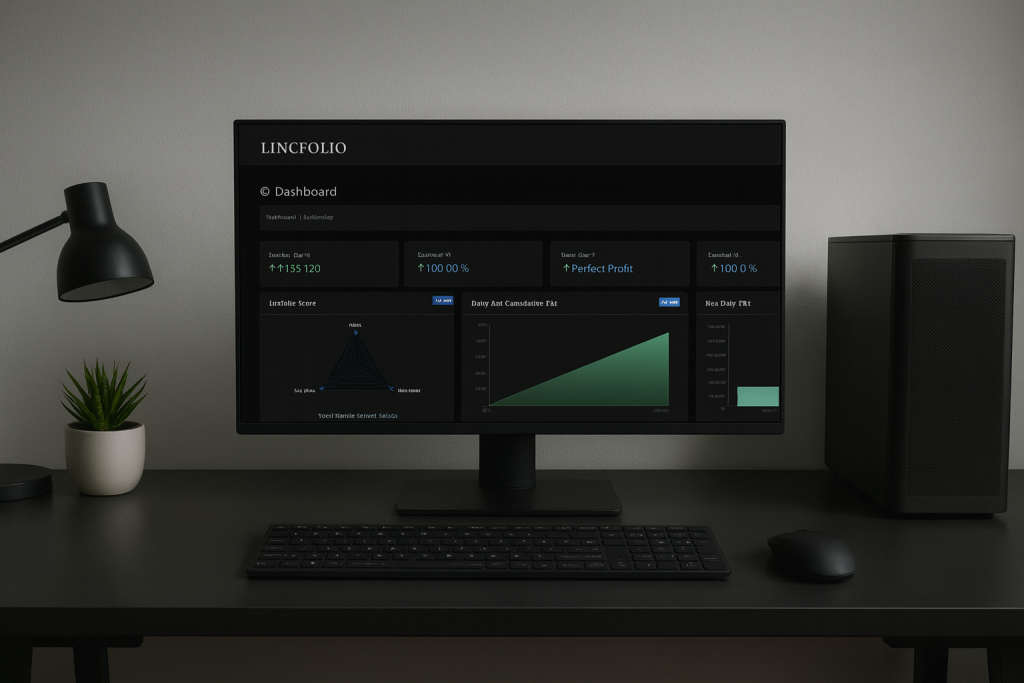
And clarity begins with documentation that’s why we built Lincfolio, India’s first trading journal platform. Lincfolio is here to make your trading journey simplified and help you become a better trader & investor. Journaling can also help you become a person who is more self=aware.
4. Long-Term Profitability Is a Risk Story
Most traders ask:
“How much can I make?”
Elite traders ask:
“How much can I lose without destroying my edge?”
Risk management isn’t defensive it is scalability.
When your downside is controlled:
confidence increases
execution smoothens
compounding begins
This is how consistent traders build capital longevity, the ability to stay in the market long enough for skill to matter more than volatility.
5. Consistency Builds Identity and Legacy
A trader who becomes consistent also becomes something else:
This identity has weight.
It has discipline.
It has direction.
Trading stops being a hustle.
It becomes a craft.
Craft creates legacy.
No one remembers the trader who made a lucky trade.
But the trader who builds a repeatable process, data-driven confidence, and long-term discipline that trader leaves a footprint.
Conclusion — Consistency Is the New Alpha
Anyone can enter the market.
Few stay long enough to command pricing power, confidence, or psychological control.
Consistency is not a skill
It is a system, a journal, and a mindset designed to protect your capital and sharpen your execution.
If profits are the outcome,
Consistency is the mechanism.
And traders who understand the mechanism
never stop compounding.